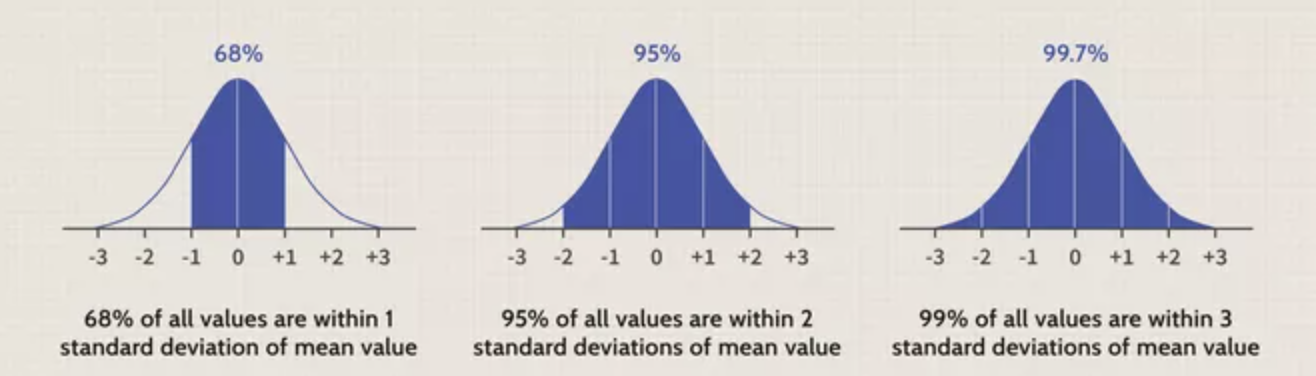
1. Intuitive Definition• CLT states that regardless what distribution you start with, if you take enough samples from the distribution, the means will be normally distributed.• What are the practical implications of knowing means are normally distributed?– When we do an experiment, we don't always know what distribution our data comes from.– Based on CLT, since we know the means are normally distributed, we don't need to worry too much about the distribution that samples came from.– We can use the mean's normal distribution to make confidence intervals. do t-tests (i.e. if there's a difference between the means of two samples), and ANOVA (i.e. if there's a difference between the means of three or more samples), or any statistical test that uses sample mean.• Note: Some say that in order for the CLT to be true, the sample size should be at least 30. – This is just a rule of thumb, and generally considered safe.– However, this rule can be broken too.• Note: In order to CLT to work at all, you have to be able to calculate a mean from your sample. – Cauchy distribution doesn't have a sample mean.2. Formal Definition• The law of large numbers says that the distribution of ⏨Xn piles up near 𝜇. This isn't enough to help us approximate probability statements about ⏨Xn. For this we need CLT.• Suppose that X1,…,Xn are i.i.d. with mean 𝜇 and variance 𝜎2. The CLT says that⏨Xn=1
n∑iXi has a distribution which is approximated by Normal distribution with mean 𝜇 and variance 𝜎2⁄n .Zn≡⏨Xn-𝜇
V(⏨Xn)=n(⏨Xn-𝜇)
𝜎⭌Zwhere Z ~ N(0,1).In other words,limn→∞P(Zn<z)=Ψ(z)=z∫-∞1
2𝜋 e-x2
2dx• In addition to Zn⭌ Z ⭌ N(0,1), there are several other notations to show that the distribution of Zn converges to a Normal distribution:– Zn≈N(0,1)– ⏨Xn≈N(𝜇,𝜎2
n)– ⏨Xn- 𝜇 ≈ N(0,𝜎2
n)– n(⏨Xn-𝜇)≈ N(0, 𝜎2)– n(⏨Xn-𝜇)
𝜎≈ N(0, 1)• This is remarkable since nothing is assumed about the distribution of Xi, except the existence of a mean and variance.• Interpretation: Probability statements about ⏨Xn can be approximated using a Normal distribution. It's the probability statements that we are approximating, not the random variable itself.• Example: Suppose that the number of errors per computer program has a Poisson distribution with mean 5. We get 125 programs. Let X1,X2,…,X125 be the number of errors in the programs. We want to approximate P(⏨Xn<5.5). – Solution:Let 𝜇=E(X1)=𝜆=5and 𝜎2=V(X1)=𝜆=5. Then,P(⏨Xn<5.5)=P(n(⏨Xn-𝜇)
𝜎<n(5.5-𝜇)
𝜎)≈P(Z<2.5)= 0.9938• – Note:In cases where we don't know the 𝜎, we can estimate it as follows,S2n=1
n-1n∑i=1(Xi-⏨Xn)2• – Note:If we replace 𝜎 with Sn, is the CLT still true?YES!
3. CLT: Investopedia• In probability theory, the central limit theorem (CLT) states that the distribution of a sample variable approximates a normal distribution as the sample size becomes larger, assuming that all samples are identical in size, and regardless of the population's actual distribution shape.– Put another way, CLT is a statistical premise that, given a sufficiently large sample size from a population with a finite level of variance, the mean of all sampled variables from the same population will be approximately equal to the mean of the whole population.– Furthermore, these samples approximate a normal distribution, with their variances being approximately equal to the variance of the population as the sample size gets larger, according to the law of large numbers.• The central limit theorem is often used in conjunction with the law of large numbers, which states that the average of the sample means and standard deviations will come closer to equaling the population mean and standard deviation as the sample size grows, which is extremely useful in accurately predicting the characteristics of populations.
3.1. CLT in Finance• Say, for example, an investor wishes to analyze the overall return for a stock index that comprises 1,000 equities. • In this scenario, that investor may simply study a random sample of stocks to cultivate estimated returns of the total index. • To be safe, at least 30-50 randomly selected stocks across various sectors should be sampled for the central limit theorem to hold. • Furthermore, previously selected stocks must be swapped out with different names to help eliminate bias.3.2. Why is CLT useful?• The central limit theorem is useful when analyzing large data sets because it allows one to assume that the sampling distribution of the mean will be normally-distributed in most cases. This allows for easier statistical analysis and inference. • For example, investors can use central limit theorem to aggregate individual security performance data and generate distribution of sample means that represent a larger population distribution for security returns over a period of time.