Transformer Models: An Introduction & Catalog
This article is written by Xavier Amatriain in January 2023.
Update 01/16/2023
Six months after my last update, it is clear that the world has been taken by storm by Transformers. Everyone is talking about ChatGPT, so I thought I needed to add the models that got us there. I had already talked about GPTInstruct before, but I added GPT3.5 and ChatGPT as independent models although they don’t add too much to the former. I also added a couple of models from Eleuther.ai and Anthropic, the only two startups that seem to be even ready to challenge the OpenAI/Facebook/Google supremacy in language models. Because of what is happening with ChatGPT, I thought I should add the main competitors from the big labs: Sparrow from Deepmind/Google, and Blenderbot3 from Facebook. Speaking of startups though, there has been a lot of talk of Stability.ai, so I felt I needed to add a reference to StableDiffusion. Finally, and while not many details are known about AlphaFold’s architeccture, I thought I should add a reference to it since the problem of protein folding is very important, and Deepmind’s accomplishment in this regard is huge.
Also, there are two concepts that are becoming more and more important in the recent success of Transformers: On the one hand, RLHF (Reinforcement Learning with Human Feedback) for language models. On the other hand, Diffusion models. I added a brief section on both these topics.
Now that I am including over 50 Transformers I thought I should highlight those that for some reason I consider to be noteworthy. I hope the others don’t feel bad about it :-) I also felt that very often I was searching for Transformer model timelines and none was comprehensive enough, so I bit the bullet and added a timeline view to the catalog.
Enjoy! And, as always, human feedback is welcomed.
Why this post
I have a terrible memory for names. In the past few years we have seen the meteoric appearance of dozens of models of the Transformer family, all of which have funny, but not self-explanatory, names. The goal of this post is to offer a short and simple catalog and classification of the most popular Transformer models. In other words, I needed a Transformers cheat-sheet and couldn’t find a good enough one online, so I thought I’d write my own. I hope it can be useful to you too.
What are Transformers
Transformers are a class of deep learning models that are defined by some architectural traits. They were first introduced in the now famous Attention is All you Need paper by Google researchers in 2017 (the paper has accumulated a whooping 38k citations in only 5 years) and associated blog post.
The Transformer architecture is a specific instance of the encoder-decoder models that had become popular just over the 2–3 years prior. Up until that point however, attention was just one of the mechanisms used by these models, which were mostly based on LSTM (Long Short Term Memory) and other RNN (Recurrent Neural Networks) variations. The key insight of the Transformers paper was that, as the title implies, attention could be used as the only mechanism to derive dependencies between input and output.
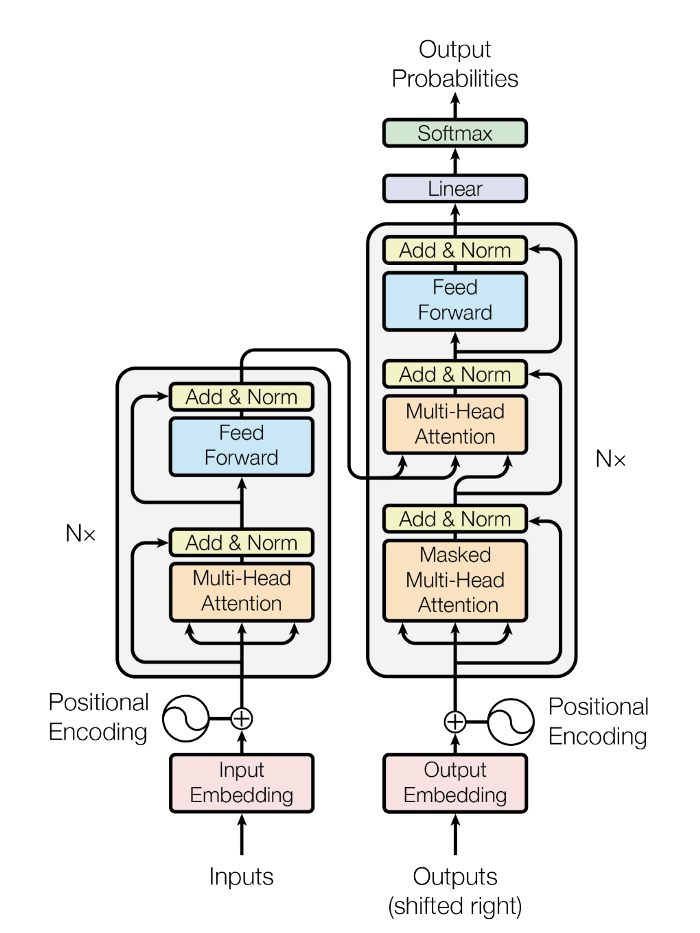
It is beyond the scope of this blog to go into all the details of the Transformer architecture. For that, I will refer you to the original paper above or to the wonderful The Illustrated Transformer post. That being said, we will briefly describe the most important aspects since we will be referring to them in the catalog below. Let’s start with the basic architectural diagram from the original paper, and describe some of the components.
Encoder/Decoder architecture
A generic encoder/decoder architecture is made up of two models. The encoder takes the input and encodes it into a fixed-length vector. The decoder takes that vector and decodes it into the output sequence. The encoder and decoder are jointly trained to minimize the conditional log-likelihood. Once trained the encoder/decoder can generate an output given an input sequence or can score a pair of input/output sequences.
In the case of the original Transformer architecture, both encoder and decoder had 6 identical layers. In each of those 6 layers the Encoder has two sub layers: a multi-head attention layer, and a simple feed forward network. Each sublayer has a residual connection and a layer normalization. The output size of the Encoder is 512. The Decoder adds a third sublayer, which is another multi-head attention layer over the output of the Encoder. Besides, the other multi-head layer in the decoder is masked to prevent attention to subsequent positions.
Attention
It is clear from the description above that the only “exotic” elements of the model architecture are the multi-headed attention, but, as described above, that is where the whole power of the model lies! So, what is attention anyway? An attention function is a mapping between a query and a set of key-value pairs to an output. The output is computed as a weighted sum of the values, where the weight assigned to each value is computed by a compatibility function of the query with the corresponding key. Transformers use multi-headed attention, which is a parallel computation of a specific attention function called scaled dot-product attention. I will refer you again to the The Illustrated Transformer post for many more details on how the attention mechanism works, but will reproduce the diagram from the original paper here so you get the main idea
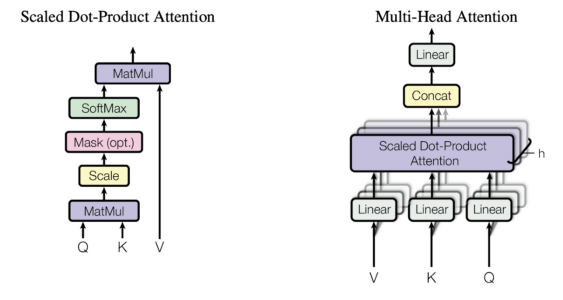
There are several advantages of attention layers over recurrent and convolutional networks, the two most important being their lower computational complexity and their higher connectivity, especially useful for learning long-term dependencies in sequences.
What are Transformers used for and why are they so popular
The original transformer was designed for language translation, particularly from English to German. But, already the original paper showed that the architecture generalized well to other language tasks. This particular trend became quickly noticed by the research community. Over the next few months most of the leaderboards for any language-related ML task became completely dominated by some version of the transformer architecture (see for example the well known SQUAD leaderboard for question answer where all models at the top are ensembles of Transformers).
One of the key reasons Transformers were able to so quickly take over most NLP leaderboards is their ability to quickly adapt to other tasks, a.k.a. Transfer learning. Pretrained Transformer models can adapt extremely easily and quickly to tasks they have not been trained on, and that has huge advantages. As an ML practitioner, you no longer need to train a large model on a huge dataset. All you need to do is re-use the pretrained model on your task, maybe just slightly adapting it with a much smaller data set. A specific technique used to adapt pretrained models to a different task is the so-called fine tuning.
It turns out that the capability of Transformers to adapt to other tasks is so great, that, while they were initially developed for language related tasks, they quickly became useful for other tasks ranging from vision or audio and music applications all the way to playing chess or doing math!
Of course all these applications would have not been possible if it wasn’t because of the myriad of tools that made them readily available to anyone that could write a few lines of code. Not only were Transformers quickly integrated into the main AI frameworks (namely Pytorch and TF), but they even enabled the creation of an entire company around them. Huggingface, a startup that has raised over $60M to this day, is almost entirely built around the idea of commercializing their open source Transformers library.
Last but not least, I would be remiss if I did not mention the impact of GPT-3 on the popularization of Transformers. GPT-3 is a Transformer model introduced by OpenAI in May 2020 as a follow up to their earlier GPT and GPT-2. The company made a big splash by introducing the model in a preprint in which they claimed that the model was so powerful that they were not in a position to release it to the world. Since then, the model has not only been released, but also commercialized through a very large partnership between OpenAI and Microsoft. GPT-3 powers over 300 different applications, and is the foundation for OpenAI’s commercial strategy (which is a lot to say for a company that has received over $1B in funding).
RLHF
Reinforcement Learning from Human Feedback (or Preferences) aka RLHF (or RLHP) has become a huge addition to the AI toolkit as of lately. The concept was introduced already in 2017 in the paper “Deep reinforcement learning from human preferences”. More recently though, it has been applied to ChatGPT and similar dialog agents like BlenderBot3 or Sparrow. The idea is pretty simple though: Once a language model is pretrained, we can generate different responses to a dialog and have Humans rank the results. We can use those ranking (aka preferences or feedback) to train a reward, in the reinforcement learning context. You can read much more in these two wonderful posts by Huggingface or Weights and Bias.
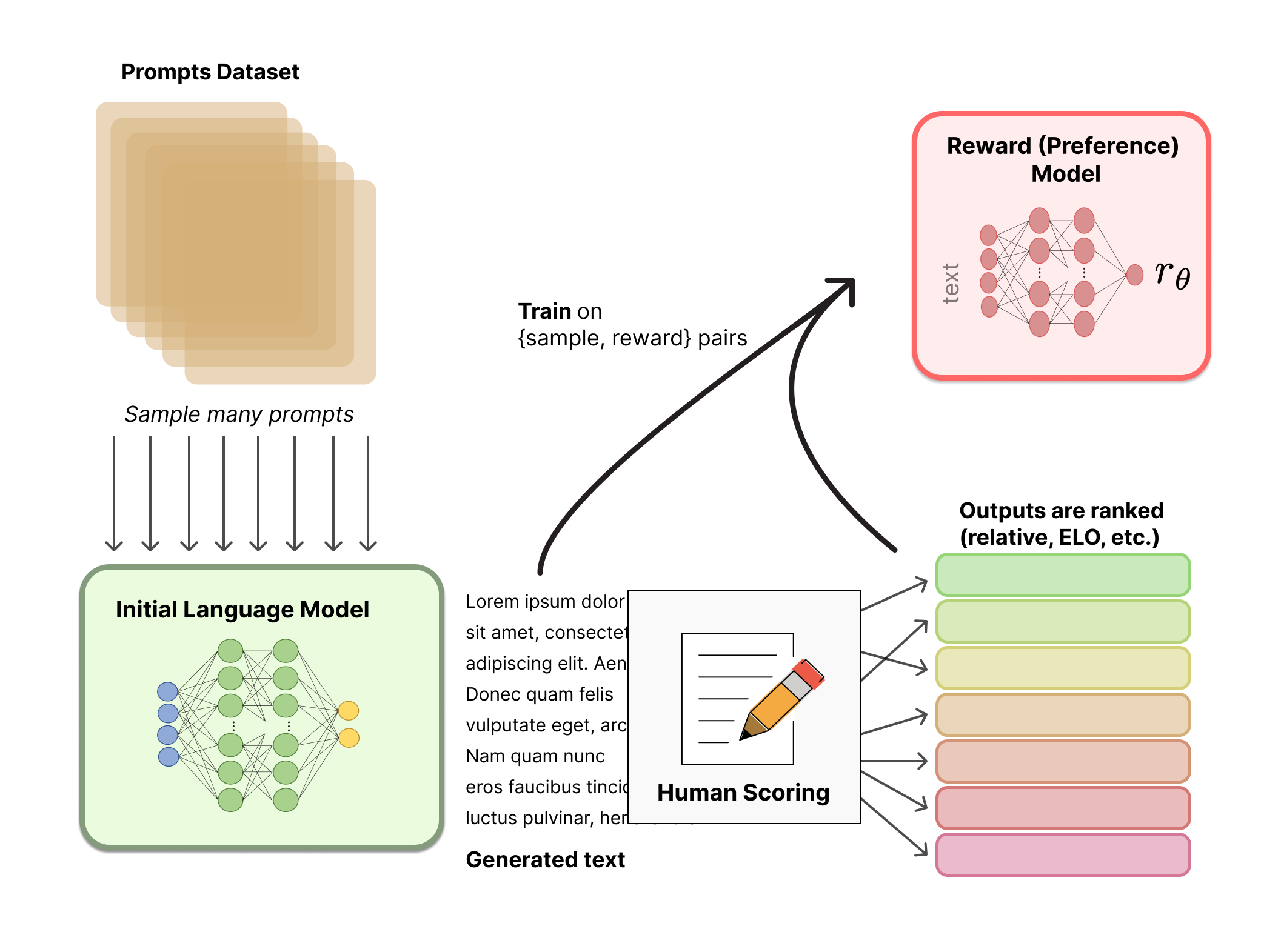
From HuggingFace’s RLHF blog post.
Diffusion Models
Diffusion models have become the new SOTA in image generation, clearly pushing aside the previous approaches such as GANs (Generative Adversarial Networks). What are diffusion models? They are a class of latent variable models trained variational inference. What this means in practice is that we train a deep neural network to denoise images blurred with some sort of noise function. Networks that are trained this way are in fact learning the latent space of what those images represent.
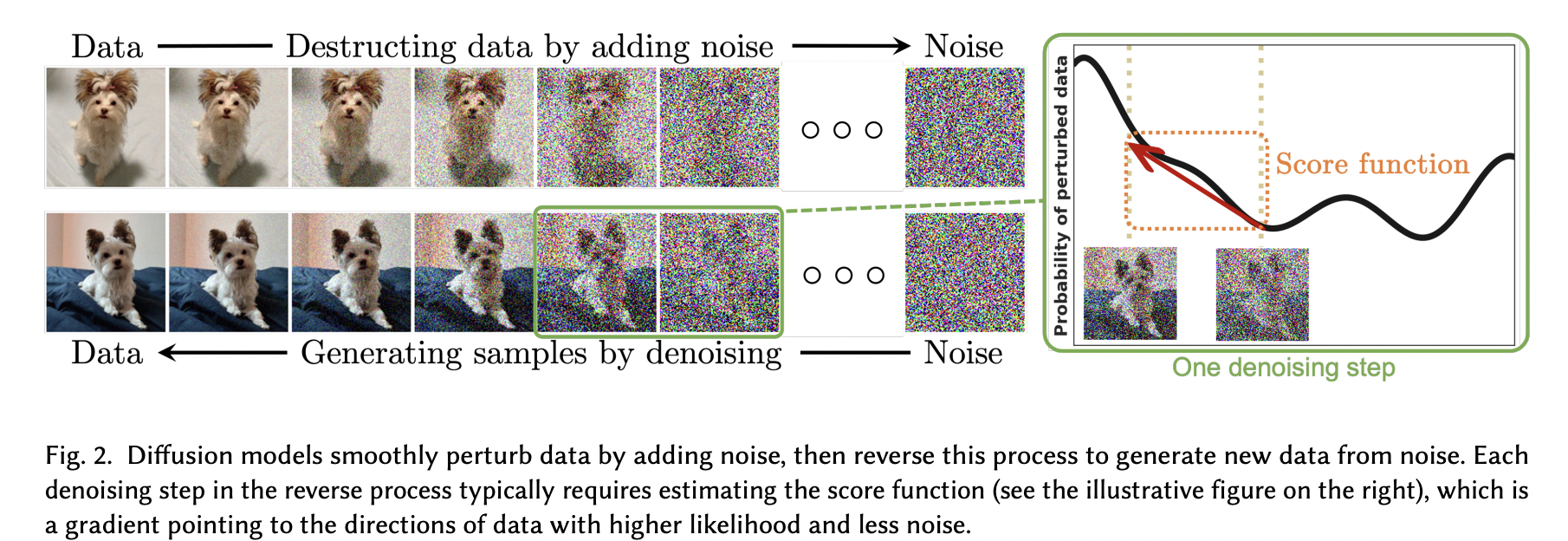
From “Diffusion Models: A Comprehensive Survey of Methods and Applications”
Diffusion models have relation with other generative models like the famous Generative Adversarial Networks (GAN), which they have mostly replaced in many applications and, particularly with (denoising) Autoencoders. Some authors will go as far as saying that Diffusion models are just a specific instance of autoencoders. However, they also admit that the small differences do transform their application, from the latent representation of autoconders to the pure generative nature of Diffusion models.
The Transformers catalog
So hopefully by now you understand what Transformer models are, and why they are so popular and impactful. In this section I will introduce a catalog of the most important Transformer models that have been developed to this day. I will categorize each model according to the following properties: Pretraining Architecture, Pretraining Task, Compression, Application, Year, and Number of Parameters. Let’s briefly define each of those:
Pretraining Architecture
We described the Transformer architecture as being made up of an Encoder and a Decoder, and that is true for the original Transformer. However, since then, different advances have been made that have revealed that in some cases it is beneficial to use only the encoder, only the decoder, or both.
Encoder Pretraining
These models, which are also called bi-directional or auto-encoding, only use the encoder during pretraining, which is usually accomplished by masking words in the input sentence and training the model to reconstruct. At each stage during pretraining, attention layers can access all the input words. This family of models are most useful for tasks that require understanding complete sentences such as sentence classification or extractive question answering.
Decoder Pretraining
Decoder models, often called auto-regressive, use only the decoder during a pretraining that is usually designed so the model is forced to predict the next word. The attention layers can only access the words positioned before a given word in the sentence. They are best suited for tasks involving text generation.
Transformer (Encoder-Decoder) Pretraining
Encoder-decoder models, also called sequence-to-sequence, use both parts of the Transformer architecture. Attention layers of the encoder can access all the words in the input, while those of the decoder can only access the words positioned before a given word in the input. The pretraining can be done using the objectives of encoder or decoder models, but usually involves something a bit more complex. These models are best suited for tasks revolving around generating new sentences depending on a given input, such as summarization, translation, or generative question answering.
Pretraining Task
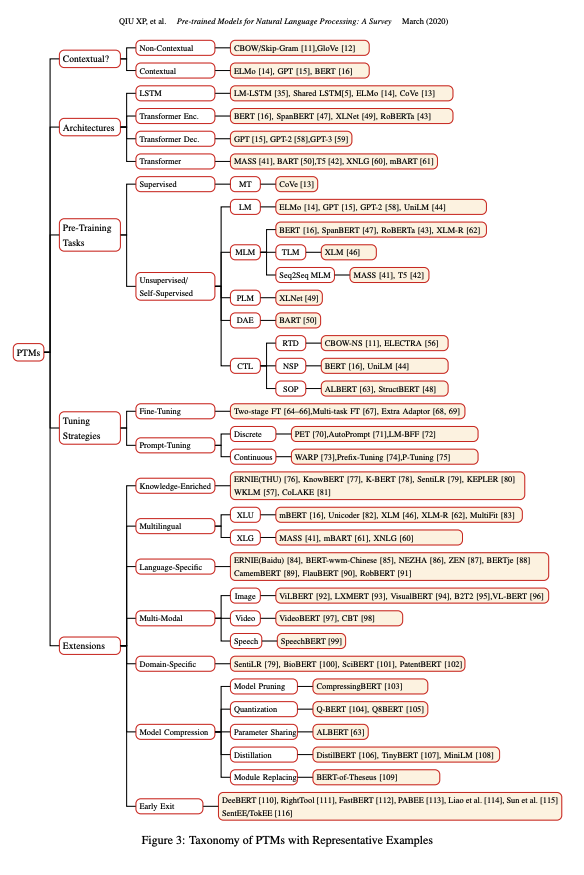
When training a model we need to define a task for the model to learn on. Some of the typical tasks, such as predicting the next word or learning to reconstruct masked words were already mentioned above. “Pre-trained Models for Natural Language Processing: A Survey” includes a pretty comprehensive taxonomy of pretraining tasks, all of which can be considered self-supervised:
- Language Modeling (LM): Predict next token (in the case of unidirectional LM) or previous and next token (in the case of bidirectional LM)
- Masked Language Modeling (MLM): mask out some tokens from the input sentences and then trains the model to predict the masked tokens by the rest of the tokens
- Permuted Language Modeling (PLM): same as LM but on a random permutation of input sequences. A permutation is randomly sampled from all possible permutations. Then some of the tokens are chosen as the target, and the model is trained to predict these targets.
- Denoising Autoencoder (DAE): take a partially corrupted input (e.g. Randomly sampling tokens from the input and replacing them with [MASK] elements. randomly deleting tokens from the input, or shuffling sentences in random order) and aim to recover the original undistorted input.
- Contrastive Learning (CTL): A score function for text pairs is learned by assuming some observed pairs of text that are more semantically similar than randomly sampled text. It includes: Deep InfoMax (DIM): maximize mutual information between an image representation and local regions of the image; Replaced Token Detection (RTD): predict whether a token is replaced given its surroundings; Next Sentence Prediction (NSP): train the model to distinguish whether two input sentences are continuous segments from the training corpus; and Sentence Order Prediction (SOP): Similar to NSP, but uses two consecutive segments as positive examples, and the same segments but with their order swapped as negative examples
Application
Here we will note what are the main practical applications of the Transformer model. Most of these applications will be in the language domain (e.g. question answering, sentiment analysis, or entity recognition). However, as mentioned before, some Transformer models have also found applications well beyond NLP and are also included in the catalog.
Catalog table
Note: For all the models available in Huggingface, I decided to directly link to the page in the documentation since they do a fantastic job of offering a consistent format and links to everything else you might need, including the original papers. Only a few of the models (e.g. GPT3) are not included in Huggingface.
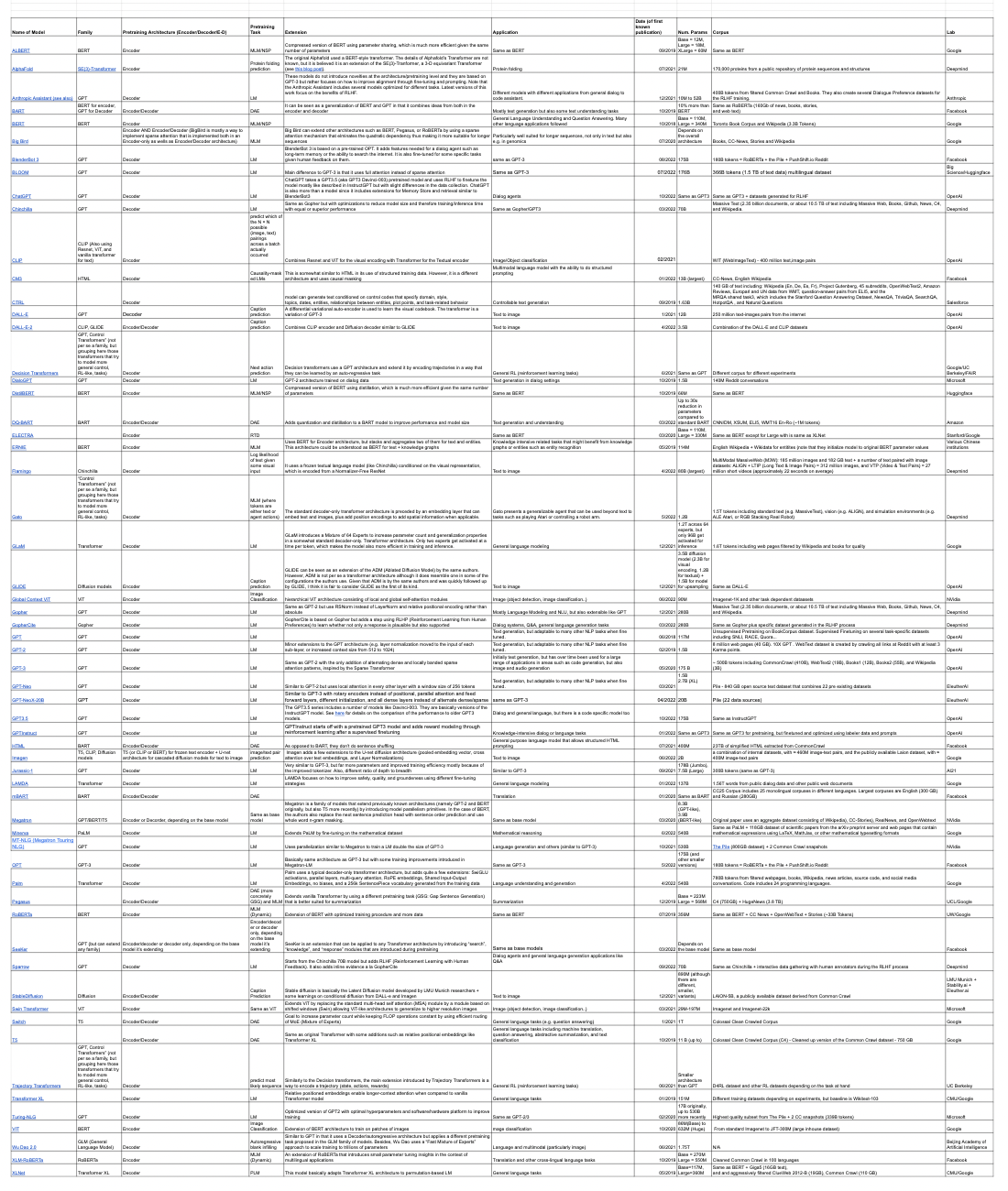
You can access the original table here for easier browsing across the different model features. If you prefer to read the full list see below.
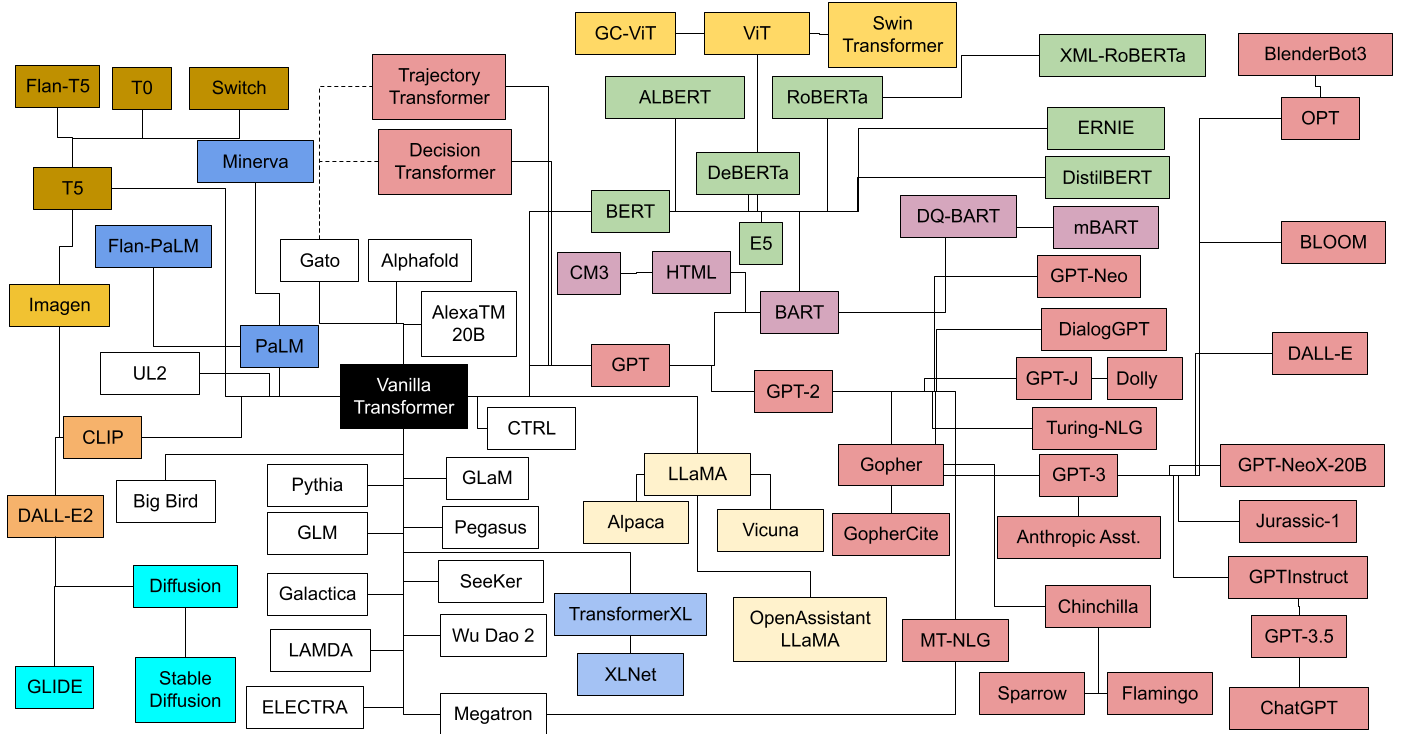
Family Tree
The diagram below is just a simple view that should highlight the different families of transformers and how they relate to each other.
Chronological Timeline
Another interesting perspective of the catalog is to see it as a chronological timeline. Here you will find all the transformers in the catalog sorted by their date of publication. In this first visualization, the Y-axis is only used to cluster transformers of related heritage/family.
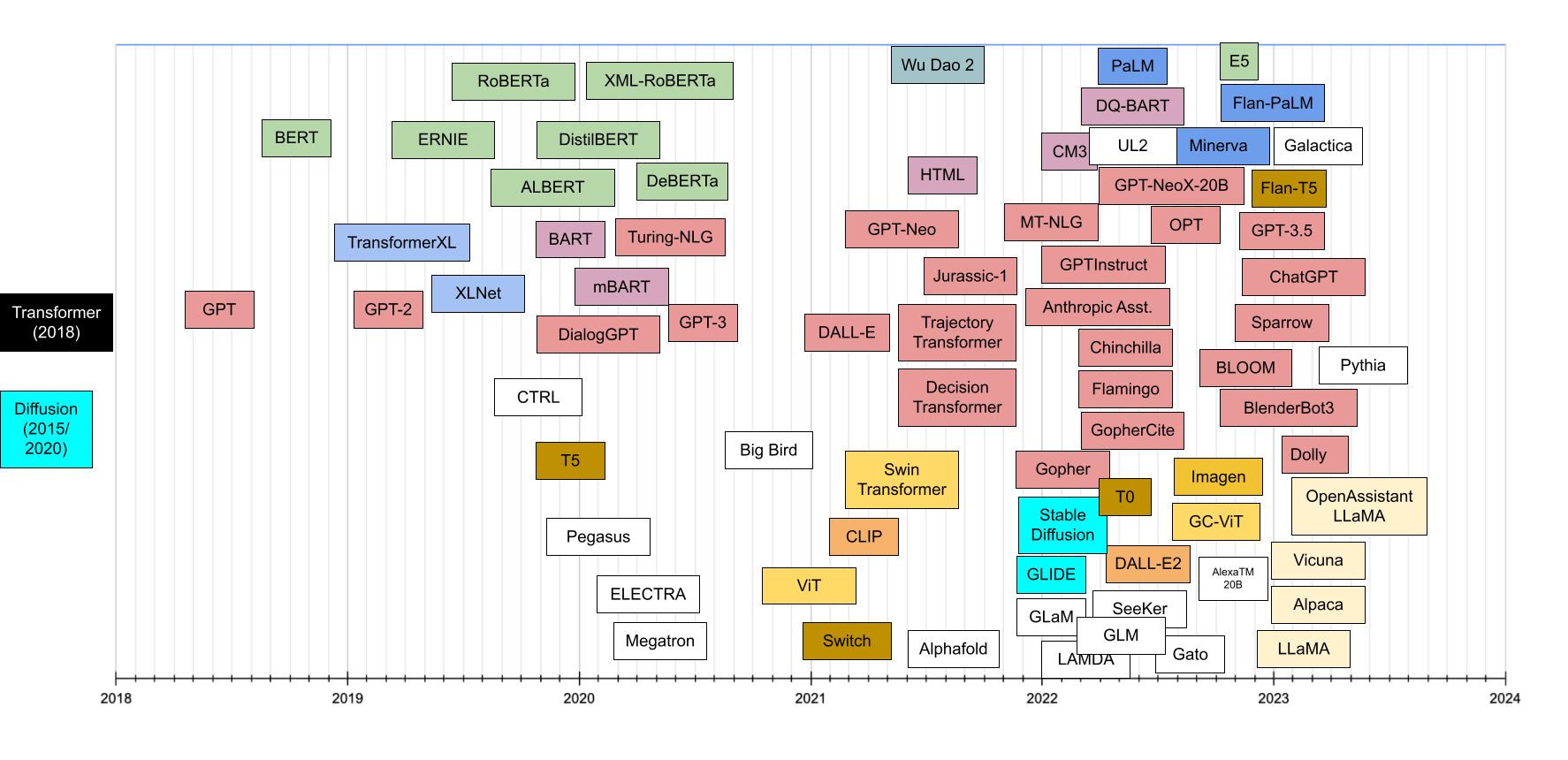
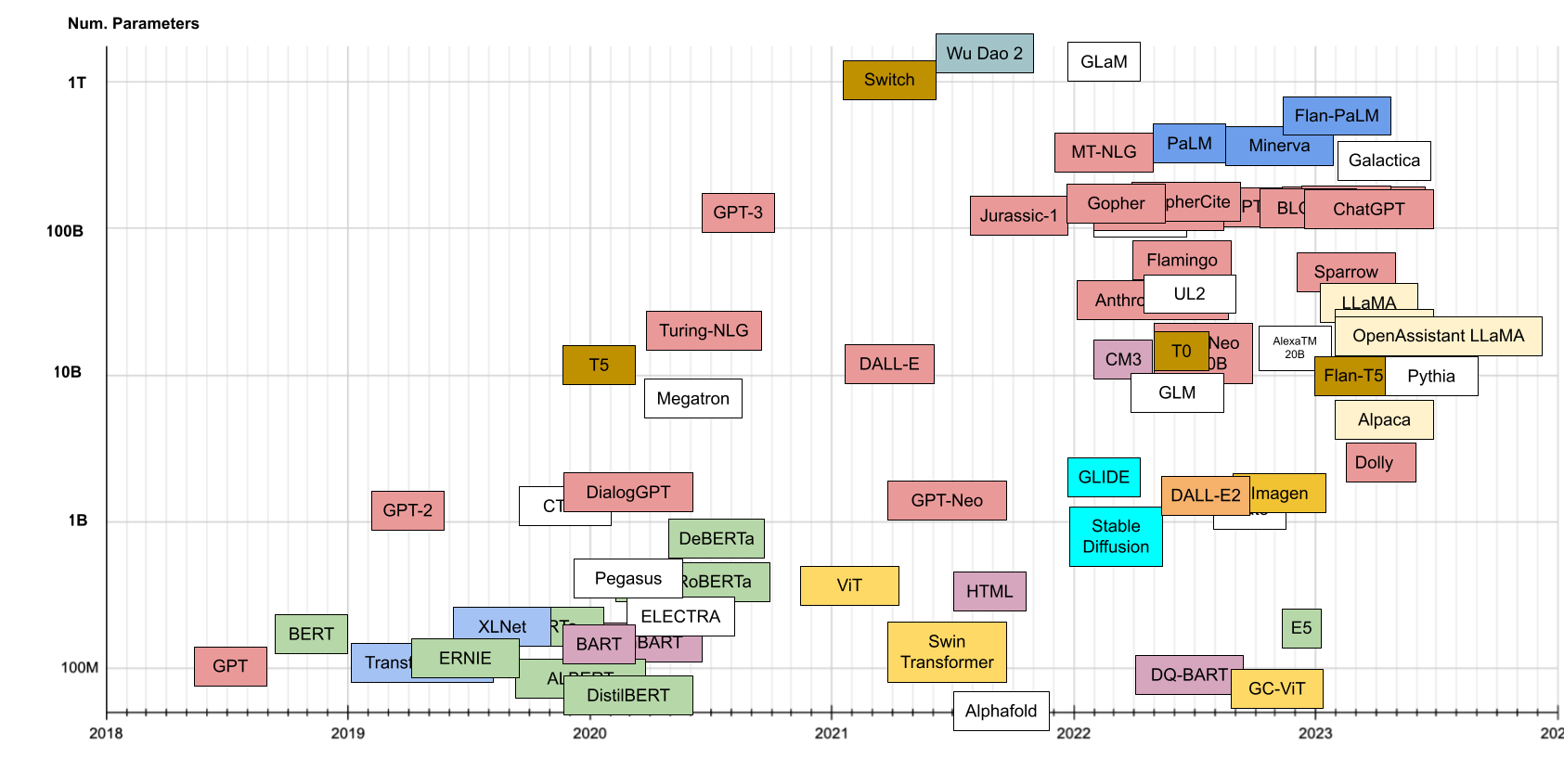
In this next visualization, the Y-axis represents model size in millions of parameters. You won’t be able to see all the models in the catalog since many fall right on the same time and size, so please refer to the previous image for that.
Catalog List
Finally, here is a list view that might be easier to follow along in some cases:
Further reading
Most of the following references have already been mentioned in the post. However, it is worth listing them here in case you need more details:
- The Huggingface Transformers documentation and course is extremely good and comprehensive. I have used myself in this post, and I can’t recommend enough as a natural follow up to what you will find here.
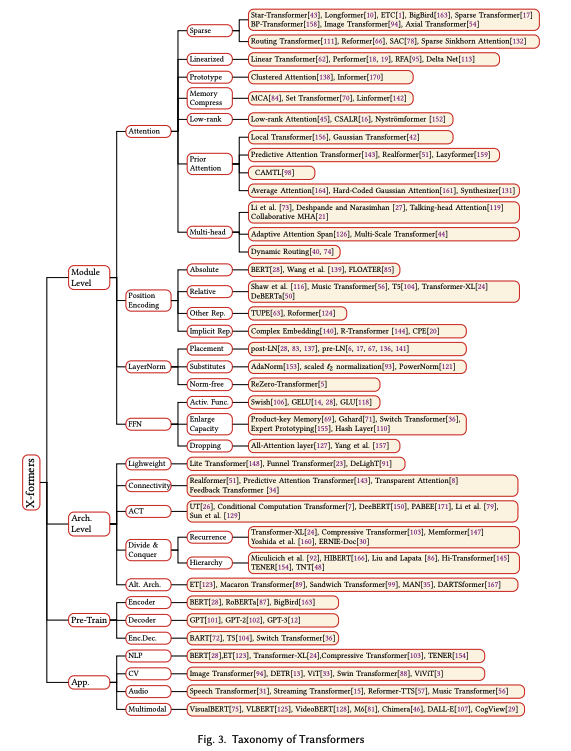
- A survey of transformers (Lin et al. 2021) includes a 40 page long survey wit over 170 references and a full blown taxonomy.
- Pre-trained Models for Natural Language Processing: A Survey is also a very comprehensive survey that includes many of the pretrained models with a particular focus on NLP
- Pre-trained Models for Natural Language Processing: A Survey (Quiu et al. 2021) is another 30+ pages long survey that focuses on pretrained models for NLP.